





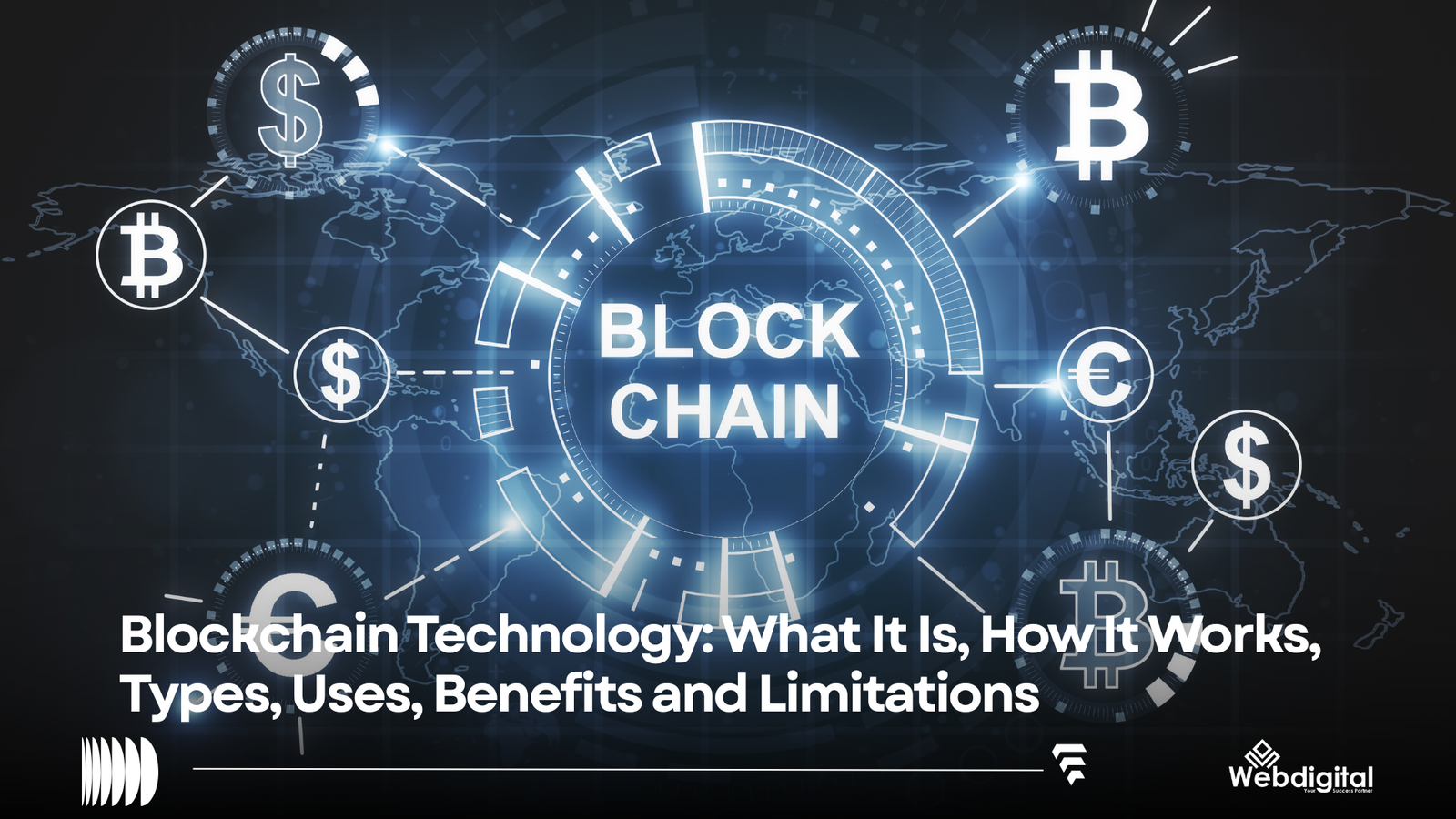
Blockchain is a system for logging and sharing data across multiple computers in a way that allows all participants to access and verify an immutable, block-by-block linked record of the data. With blockchain, participants do not rely on a single central database administrator.
Although blockchain technology was created to facilitate the functioning of cryptocurrencies, it has many other uses. Some of these uses include keeping track of and managing titles, deeds, and other forms of ownership; records and certificates; licenses; contracts; votes; and bank transfers.
Blockchain makes it possible to create a record that is Verifiable and irreparably alterable. To achieve this, blockchain uses a system whereby a record to be added to the system is created and shared by several different participants.
Each participant puts a section of the record on the system and links it to the records on the system using cryptography. Because each record in a blockchain is linked to other records, a blockchain is usually a long, chronologically ordered record.
A blockchain is a type of distributed ledger system, and it is similar to other types of DLTs. Unlike traditional systems, several participants share control of a blockchain. Once data is added to a blockchain, it is virtually impossible to change.
There are design variations of blockchain technology which include:
- A publicly operated network
- A privately operated, company-owned network
- A permissioned network
- A consortium operated network
- A combination of the above
It is therefore true to say that not all blockchains are the same.
In the context of distributed ledger technology, a blockchain is a direct, append-only, chronological and exponentially growing ledger.
How does Blockchain work?
Every blockchain network operates using a distinct mechanism. However, a general representation of a blockchain process is outlined as follows.
A record is created
In a blockchain network, a participant (or node) creates a record (or transaction) to be broadCast to the network.
The broadCast record is received by several participating nodes.
A record is validated
Upon receipt of the broadCast record, each node is mandated to verify if the record conforms to a set of pre-defined rules.
A record is broadCast to the network only if it is validated by the node.
A blockchain network uses a distinct consensus mechanism to validate broadCast records and reach a consensus.
Valid transactions are grouped together into a block.
Blocks can consist of many pieces of information including;
- Data from the transaction
- The time and/or data the transaction occurred
- Information that connects the block to other blocks of the chain
- A special type of code
- Other pieces of information that are important to the function of the blockchain
Once a group of blocks have been validated by the network they are added to the chain. Each block of the chain contains information that connects it to previous blocks and because of this, changing data of old blocks creates a contradiction. In order for data to be changed on old blocks, all the participants of the network have to reach an agreement to do so. The participants of the network are connected to each other via the internet. When data is recorded on a block of the chain, it is recorded on all participants of the network. This process is repeated to create a record of all transactions that have occurred on the blockchain. To function blockchains rely on many complicated and unique technologies including, a distributed ledger, special codes, and other elements.
Hashes connect the blocks of a blockchain. When the data in a block changes, the hash is also changed. The blockchain protocol uses hashing to allow users to trace blocks and detect tampering.
Therefore blockchain data is called tamper-evident data.
Digital Signatures
A digital signature is created by using the signer’s private key to generate an electronic signature which is then attached to a document. The document along with the electronic signature is also referred to as a transaction. The document along with the digital signature is referred to as a message. Digital signatures help prove that a person has endorsed a document.
Nodes
In a blockchain, a computer or a device that is used to validate blockchain transactions is known as a node. The responsibilities of different nodes in a blockchain varies depending upon the type of node.
Consensus Mechanisms
A blockchain network uses a consensus mechanism to come to a common agreement on the blockchain transactions that are valid.
There are different types of consensus mechanisms and protocols.
Smart Contracts
A smart contract is a computer program that is coded to perform a function after a particular event has occurred. For example, a smart contract can be coded in a way to release a digital payment after a specified event has occurred.
Blockchain platforms like Ethereum allow their users to build and develop decentralized applications and services using smart contracts.
Examples are Bitcoin and Ethereum.
Along with various decentralized applications and digital assets, public blockchains enabletransactions and verification.
What is a Private Blockchain?
A blockchain is said to be private if only selected or specified players are invited to participate in the network.
Generally, private blockchains are deployed if a and b above are true.
What is a Consortium Blockchain?
A consortium blockchain is managed by more than one (but less than all) organizations in a network.
This is useful when there is a need to balance control of information and process integration across a group of organizations.
What is a Hybrid Blockchain?
A hybrid blockchain combines features of both public and private blockchains.
A public blockchain can be designed to restrict certain information while allowing the public to validate transactions.
AWS identifies the main blockchain architectures as public, private, hybrid and consortium.
What is Blockchain Technology?
Blockchain technology can be used to create secure, transparent and immutable records and can be used to facilitate inter-party financial and non-financial transactions.
Cryptocurrencies
Blockchain technology was initially created to facilitate cryptocurrency transactions.
One blockchain can be configured to facilitate transactions of several cryptocurrencies.
Other Financial Transactions
Transactions other than cryptocurrency transactions can also be supported using blockchain technology.
Supply Chain Management
Blockchain can be used to create an immutable and verifiable record of a good’s journey across a supply chain.
Transactions can be validated using blockchain technology.
Examples of information can include:
- Where a product was made
- How a product was made
- How a product was shipped
- When a product was purchased or sold
- How a product was delivered
- Who is allowed to receive the information
A shared record can be used to record information and assist in tracking the information across various record keeping systems.
Blockchain technology can help achieve some of the requirements of the revised market abuse directive (MiFID II).
Blockchain technology can assist in verifying the identity of an individual or organization.
Blockchain technology can assist in tracking or managing records or data.
Blockchain technology can help achieve consent management for health records.
Blockchain technology has the potential to help record the title to property.
Tokens may be created to represent a legal interest in property. A token may be created to represent an individual’s right to a gift or bequest, for example.
Government and authorized entities can use blockchain technology to create and maintain records.
The main components of a blockchain system include:
- Cryptographic certificates
- Registries
- Proof of documentation
- Tracking systems for the supply chain
- Managing and verifying credentials
Of these, the tracking system for the supply chain appears to be the most challenging. This is where blockchain technology can be very beneficial.
Which Blockchain Features Are the Most Attractive?
Tamper Evidence
Blocks, by nature, build a record that is tamper evident. This is especially true with blockchains that implement cryptography to secure the records and/or blocks.
Shared Record
By nature, blockchains facilitate a record that multiple organizations can jointly view.
Traceability
Blockchains, by design, facilitate a chain of records and/or transactions. This can help to track activities of a supply chain or other records.
Reliance on Intermediaries
Transaction and record systems facilitated by blockchains can help organizations eliminate the need to rely on intermediaries to assist with processing and/or recordkeeping functions.
Automation
Blockchains can assist organizations to facilitate recordkeeping and/or transaction processing systems that are, by design, automated and workflow-based. This is often referred to as a “smart contract.”
Auditing
Blockchains facilitate a record that is designed to assist with auditing activities.
The NIST and AWS publications discuss the blockchain features that facilitate distributed and shared records and record integrity.
What are the Constraints of Blockchain?
The authors have determined that while blockchain technology is advancing, there are some features of the technology that are not likely to change. For example:
The throughput of some blockchain networks is very limited.
There are blockchain networks that are very complex to manage.
ENERGY CONSUMPTION
There are significant variations in the energy requirements of various consensus mechanisms.
Proof of Work mechanisms are effectually energy Mechanisms. Proof of Stake mechanisms are based on a different approach to blockchain security, and do not rely on a mining process, and consequently, do not inherently require large energy inputs.
There are energy efficient and intensive blockchain networks.
TRANSACTION FEES
Some public blockchains networks currently charge a fee for transaction processing.
The amount of the fee is determined by the design of the blockchain’s transaction processing and confirmation mechanism, and by the level of demand on the blockchain.
PRIVACY
Public ledgers do not imply a public organization can store and process information in an insecure manner.
By their very nature, public blockchains provide no privacy to users, and can be used to expose information that organization may wish to keep confidential.
IMPLEMENTATION ISSUES AND RISKS
Implementation of blockchain technologies can be poorly designed, and contain bugs.
Just because the blockchain on which an application is built is secure, does not mean the application itself is secure.
REGULATION AND LEGAL FRAMEWORKS
There are numerous legal and regulatory considerations relating to the use of blockchain technologies, including consumer and investor protection, privacy, tax, money laundering and terrorism financing, as well as other financial crimes.
As each jurisdiction has different laws, regulations and policies, the impacts of adopting and using blockchain technologies may vary.
IS BLOCKCHAIN TECHNOLOGY SECURE?
There are several factors that contribute to the security of blockchain technologies including cryptography, consensus mechanisms, and a distributed network architecture, to name a few.
Each blockchain has a unique security model. While blockchain can provide security, it is a misrepresentation to state that blockchain is “100% secure.”
Out-of-band risks can include susceptible wallets and brass plate exchange services, contracts, apps, and governance.
NIST notes that certain properties of blockchains can make them tamper evident and tamper resistant. There are circumstances under which it is possible to change data in a blockchain.
Blockchain vs. Traditional Database
Though they serve the same general purpose, blockchains and traditional databases have fundamental differences.
Traditional Database Blockchain
Control Centralized Distributed
Data Modification Attributes determined by the database design
Governance Database Administrators Rules established and enforced by consensus
Consensus Not Applicable
Transparency Administrator Controlled Public to Permissioned
Performance I/O Intensive Processing Throughput Limited
Best Case Scenario Fast and Flexible Database Operations
Best Case Scenario Multi-Party Trusted and Coordination Problems
Is blockchain a better than a database? Not necessarily, but when blockchain’s special properties are aligned with the needs of a given problem, blockchain can be an effective solution. When there is a centralized trusted entity, and a traditional database is needed for fast, flexible data management, blockchain is not the solution. When there are multiple independent entities and a centralized trusted entity is not desirable, blockchain may be a good solution.
What is the difference between blockchain and bitcoin?
Bitcoins and blockchains are different things. The blockchain technology has many potential uses beyond it’s best know use case, the bitcoin cryptocurrency.
Blockchain is the technology. Bitcoin is the first digital currency created by utilizing this technology.
In the case of blockchain technology, we can build many different systems.
These systems could include:
- Financial systems
- Digital credentials
- Decentralized Applications
- Tokenized Assets
- Supply Chains
- Smart Contracts
Bitcoin, on the other hand, is focused on the introduction and usage of a new currency in the electronic world.
Blockchain and Cryptocurrency
Cryptocurrency is a broad term and encompasses digital currencies of all kinds.
Blockchain is the technology that forms the foundation and provides the backbone of various cryptocurrencies.
Not every blockchain application will result in the creation of a new cryptocurrency.
Also, not every digital currency is associated and linked with blockchain.
Blockchain and Web3
Blockchain is one of the fundamental technologies of Web3.
There are other technologies of Web3 as well.
Some of the Web3 applications can include:
- Decentralized applications
- Tokens
- Smart contracts
- Cryptographic wallets
- Distributed storage
- Inter-ledger communications
AWS has also documented blockchain as one of the fundamental technologies of Web3.
What are the Different Types of Blockchain Technologies?
It is expected that in the coming years, blockchain technologies will provide more advanced digital identities, smart contracts, decentralized applications, and other enterprise technologies.
An important recent change is to move beyond the question of whether a given situation can be modeled using blockchain, to assess whether a particular situation can be improved with respect to current situations by using blockchain technology.
There are a number of questions a firm must consider.
What is the access control for the data?
Are the participants in the system separate organizations?
Is a shared ledger required?
Is the data required to have integrity but be changed?
Is the data required to be kept private?
What type of control will regulate the network?
Are there safeguards in place if an error is identified?
Is integration with other (non-blockchain) systems required?
Are there legal and/or compliance constraints?
Are there constraints on the blockchain to be used?
These questions help frame a blockchain based system and help determine whether a blockchain based system is required.
Achieving the desired outcome with blockchain
It is critical to evaluate blockchain based solutions with the problem in mind, and not with the solution (blockchain) in mind.
Step 1: Define the Business Problem
One should be able to specify the particular business process that is the focus of the improvement effort.
Step 2: Identify Stakeholders
Of interest is whether different business parties need to access the same record.
Step 3: Define Required Trust
Is there a requirement to provide a single source of truth for a number of parties without a particular organization controlling that truth?
Step 4: Analyze & Compare
Consider both the advantages and the limitations of blockchain and assess them against the advantages and limitations of conventional, centralized systems and architectures, including:
- Databases
- Distributed Databases
- APIs
- Cloud
- SaaS
- Permissioned Ledgers
- Public Blockchains
Step 5: Select Best Architecture
Based on the assessment in Step 4, determine whether blockchain is an adequate option, and if it is, define the remainder of the blockchain architecture (network, consensus, data and access models).
Step 6: Review Potential Issues
Evaluate the security and privacy of your implementation. Consider the control and management of blockchain keys and other access mechanisms, as well as contract and business logic coding.
Consider data locality and other legal restrictions and implications.
Step 7: Apply Blockchain to Achievable Use Cases
Implement and assess blockchain in a controlled manner to demonstrate measurable improvements.
Blockchain Technology Frequently Asked Questions
What is blockchain?
Blockchain is a technology that helps create a digitized, shared and permitted record across a variety of parties. Information is split into blocks and are cryptographically posted to a record in a way that will allow the network to identify any adjustments to the record.
What is a blockchain transaction?
A blockchain will create a digitized record of a transaction. The record will be spread across the network. The block will be linked to other blocks and create a chain. Each block will be given a time stamp and will be enforced by network rules and regulations.
Is blockchain and bitcoin the same?
Blockchain is the technology and bitcoin is a digital currency created by the blockchain network.
What are the different types of blockchain?
The types of blockchain networks are public, private, consortium and hybrid.
What is a node in blockchain?
A node is a computer or device that is a part of a blockchain network.
What is a smart contract?
A smart contract is a contract or agreement that is represented in a computer code and created on a blockchain.
Can information on a blockchain be changed?
Information on a blockchain network can be changed; however, the changes will be obvious to the network.
Is blockchain just for cryptocurrency?
Blockchain technology can be implemented for various other financial services, digital assets, supply chains, identity, and other services.
Is blockchain better than a regular database?
Not really. Blockchain can be used for services that require shared records and ledgers and probes for auditability and trust across a network of users.
What is blockchain?
Blockchain is a system for creating and sharing records across multiple users and computers. Blockchain technology can address certain challenges for companies.
Is blockchain going to revolutionize everything?
Not everything. Blockchain should be evaluated on a case to case basis. Some challenges such as security, energy consumption and governance have not been completely solved by blockchain technologies.
In reality, blockchain can be considered a good technology for specific use cases. Before implementing blockchain, challenges like trust across a network of users should be assessed.