





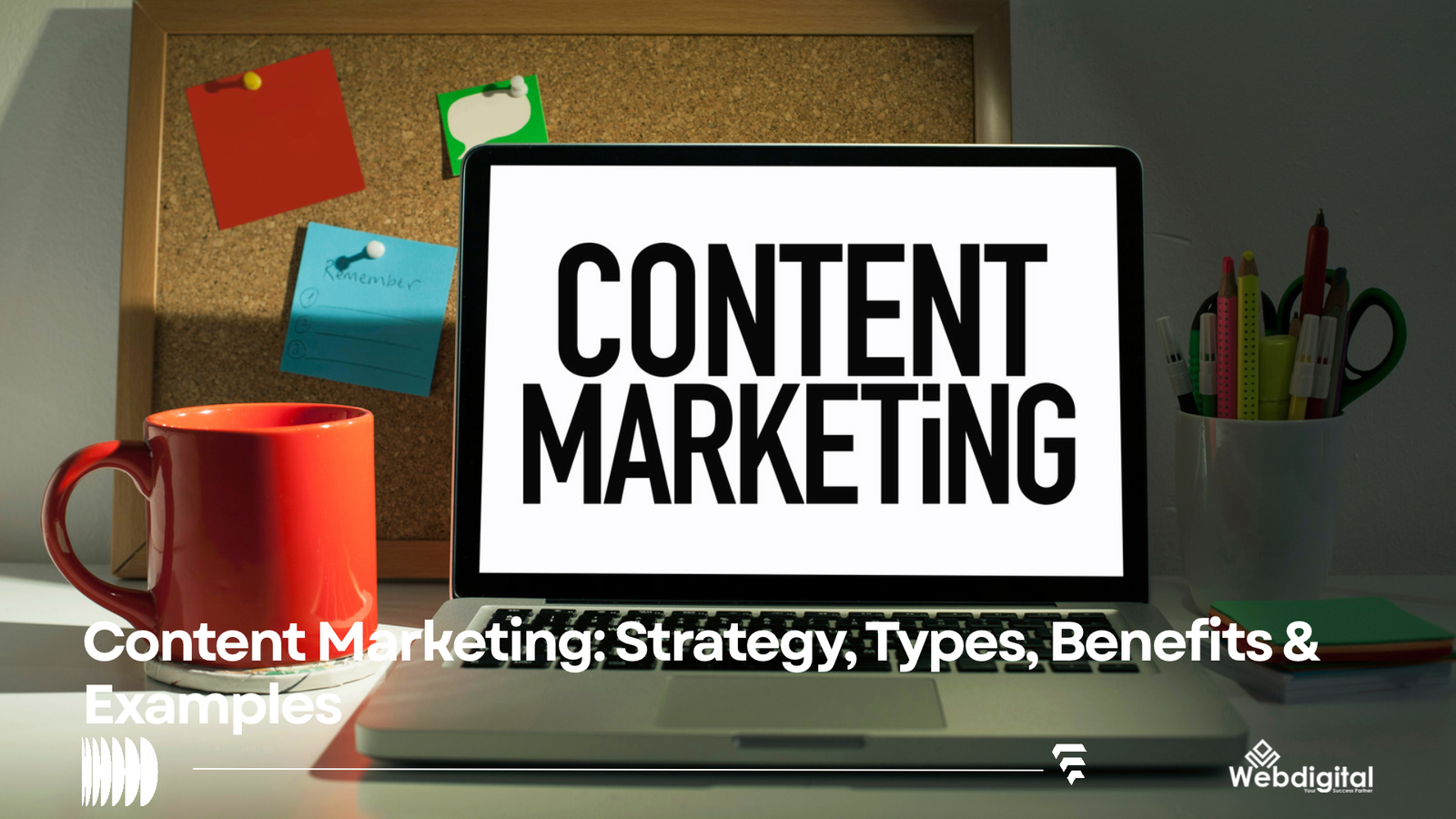
Content marketing focuses on creating content that engages the audience, draws their trust and drives them to take profitable customer actions. It takes various forms like vlogs, blog posts, social media content, case studies, email newsletters, podcasts, and other digital media.
Unlike conventional advertising, content marketing assists customers in recognizing their issues, evaluating their options and helping them make informed choices. It benefits businesses in a variety of ways like building brand awareness and visibility, improving leads and sales.
However, the goal of businesses big or small is not to increase the quantity of content. It is to create the right quality content that answers customers’ questions at the right phase of their buyer journey.
What Is Content Marketing?
Content marketing involves devising a plan to create and share useful content to the audience in order to attract and retain them, while helping the business accomplish its goals.
To illustrate, a web design business publishes a blog to help readers learn how to choose an ecommerce platform. With this article, the business owner not only gets to understand various solutions and how they work, but also develops a relationship with the business to help him with the website design.
In general, the goal of content marketing is to build relationship with customers and develop a path toward a business opportunity.
The purpose and form of content marketing varies based on the audience. It may be used to:
- Teach, inform and enlighten customers.
- Help customers understand the various options available in the market.
- Bring information to customers’ attention, improve discovery, and increase leads.
- Build trust: Provide the right information to your audience in a clear and simple way.
- Generate leads: Use incentives to motivate your website visitors to contact you, download your content, or subscribe.
- Support sales: Help potential customers compare your solutions to others in the marketplace and explain your solutions to them.
- Retain customers: Offer them support and guidance throughout their entire experience with your product.
Content marketing has a wide variety of expressions beyond a simple blog post. It is the integration of useful information to meet the demands of your audience with the business goals that are measurable.
AAMA
+2
Why Is Content Marketing Important?
Using content marketing allows your company to take part in the customer research process and provides customers with the ability to learn more about your product or service on their own without constantly having to rely on your sales team or pay for advertisements.
It has many benefits and positive effects for your business including:
1. Increased brand awareness
With useful content like videos, social media posts, and articles, you are able to broaden the discovery of your business to a wider audience.
2. Improved search engine optimization (SEO)
Content marketing can influence visitors to take action and leave your website. You can improve your rankings with search-focused content.
3. Increased trust and credibility
If your content shows expertise on a subject and provides clear information, your audience is more likely to want to learn more and consider your business.
Relying on your sales team to sell your product can’t be the only source of income for your business, you need to invest time, money, and effort into content marketing to maintain success for your business.
- Requests and adds qualified expert opinions when needed
- Updates information when products, processes, or requirements change
4. Generates Qualified Leads
When people have a need, content can help attract them.
For example, someone looking for ecommerce website development cost is likely further along in the buying process than someone looking for a basic definition of ecommerce.
A pricing guide could help answer the website visitor’s question, and provide a useful next step like a project consultation or service request.
5. Supports the Sales Process
Sales employees can use various types of content to answer frequently asked questions or address the most common concerns and objections.
6. Strengthens Customer Relationships
Content helps customers learn to use a product or service. The relationship does not end with the purchase. Useful content helps answer customers’ questions, provides product or service updates, and helps customers get the most value from their purchase. This can encourage customers to make repeat purchases.
7. Improves Other Marketing Channels
Content helps makes other marketing channels more effective because content can be reused. Publishing a single article can help improve other marketing channels. The quality of the article and how it fits the audience helps determine the benefits. The amount of traffic, leads, and sales generated depends on many factors including how well the article is distributed.
What Are the Main Types of Content Marketing?
The best approach is to select content types the audience wants, and the team can produce consistently. There are many effective formats like videos, podcasts, and articles.
1. Blog posts & SEO articles
Content that captures & answers questions, explains concepts, and provides information searchers are looking for (via organic search). This includes how-to articles, industry explainers, comparison articles, and troubleshooting.
Best for: Lead generation, topical coverage, education and organic traffic.
2. Video marketing
The introduction and explanation of a concept or process, as well as product demonstrations and staff introductions, can be accomplished through video.
Best for: Brand and product education, demonstrations and tutorials.
3. Social media content
Posts, carousels and other visuals explain industry concepts. Other short educational content, industry-related insights and reels help reach audience where they spend their time.
Best for: Building a community, engagement, content and industry-related insights distribution.
4. Email newsletters
Product education and information, special offers, and important announcements are sent via email to engaged audience members.
Best for: Lead retention and nurturing.
5. Customer case studies & stories
Case studies are accounts of a customer’s situation, the process and approach taken to address the customer’s situation, and the results and outcomes. This is done with evidence. Prospects use case studies to evaluate processes and approaches.
Best for: Evaluating processes, B2B marketing and purchase decisions.
6. Ebooks, white papers and other long-form guides
These are in-depth accounts of a process or subject, research, case studies, frameworks, templates or other resources. These are sometimes offered in exchange for information.
Best for: Specialist and in-depth audience leads.
7. Podcasts, webinars
Processes, subjects and topics requiring long-form education can be done via podcasts and webinars.
Best for: Audience relationship and education.
Other formats include FAQs, checklists, calculators, templates, research reports, customer-generated content, and interactive tools. Depending on your goals and the preferences of your audience, you can use a combination of formats for your strategy. The success of your plan relies on the objectives you want to achieve, the audience you want to target, the resources at your disposal, and the channels at your command.
SEO
A content marketing strategy is a plan that shows how a business will meet its objectives with the help of content, how the content will be created and distributed, and how the content will be evaluated. To develop a workable plan, follow the guidelines below.
1. Define your goals
Once you know the role content will play in achieving your business objectives, you will determine the specific goals you want content to achieve.
- Increase qualified organic search traffic.
- Improve service or product inquiries.
- Increase product sales.
- Improve awareness for your brand and/or services in your target industry.
- Improve customer retention.
- Reduce support requests.
There are many business goals that content marketing can help achieve. To keep the strategy focused, determine a primary goal with a few supporting goals.
2. Understand your audience
Once you can describe your audience, and have a deep understanding of their needs, then you can choose content topics that will address their needs and concerns.
To find needs and concerns, ask yourself:
- Who will make the buying decision?
- What problems do they have?
- What are the questions they have?
- What concerns do they have?
- Where do they go to research?
- What will give them the confidence to make a buying decision?
Defining your audience too broadly will lead you astray. A small business owner shopping for an affordable website developer has a lower priority for complexity than an enterprise marketing director evaluating a sophisticated digital platform.
Step 3: Research keywords and search intent
Keyword research is useful for learning what words and phrases users type into search boxes.
For the subject of Web design, some examples would be:
- Website design services
- Website development costs
- Business website design
- Ecommerce website development
- How to find a web design company
There are other factors to take into consideration than simple search volume. In keyword research, we want to pinpoint the user intent.
User intent Query Ideal Content
To learn What is content marketing? Article
To buy Best content marketing services Service page
To go Brand name login Account page
From keyword research, user intent, and search volume, you can appropriately gauge what information the user is searching for and adequately provide that content in an understandable format. From this research you should be able to identify what topics should be mapped to what pages.
Step 4: Consider the customer journey
Decide what stage of the journey a user is in and give the appropriate information for that stage.
Awareness
Give a baseline understanding of a problem
Blog posts, beginner’s guides, short videos, or infographics
- “9 Website Must-Haves”
- “What is a Multipage Website?”
Consideration
Allow users to compare alternatives
Long form content like case studies or How To’s, pricing info, and service comparisons
- “Custom Website vs. Website Builder”
- “301 vs 302 Redirect”
Decision
Provide guidance and support for next steps
Contact info, project case studies, FAQs, consultations, service pages
- “Wordpress vs Wix”
- “HIPAA Compliant Hosting”
Example: “Website Design Packages and What’s Included”
Once customers purchase your product, provide resources to help them make the most out of it. Create guides, tutorials and instructional material that help customers with the onboarding process and answer maintenance and troubleshooting questions.
Example: “How to Maintain Your Business Website”
There are various stages of the buyer’s journey and content should be created that covers each stage. Educational content draws in visitors while content that addresses the decision stage aids in converting leads to buyers.
Step 5: Choose the right content formats and channels
You can’t publish on every channel from the start.
Come up with a manageable combination based on your audience and resources. A combination could be a blog with a focus on SEO, social media posts, and an email newsletter. For an ecommerce business, an initial combination could be posts on social media and blogs showing product demos and customer stories.
Consider the audience and what best conveys the message. Sponsored posts are a good way to promote business and distribute content.
Step 6: Create genuinely useful content
Before writing or recording, figure out exactly what your audience should learn or do as a result of the content. Provide a content brief to the writer or editor that includes main points, supporting subpoints, examples, and evidence. Links to relevant content should be included to help readers take the next step. Specify who should review and edit the content. When appropriate, explain how the content should be structured, logical, and clear. When making claims, create a citation to support the claim.
Step 7: Distribute and Repurpose Content
Distribution is as important as publishing. Each piece must have a plan for getting it into the right hands.
Repurpose comprehensive pieces into multiple formats for different audiences.
One long-form article can be transformed into:
- 3 short educational social media posts.
- A short explanatory video.
- A summarized version to be included in a newsletter.
- An internal sales team reference.
- A list of common customer questions and answers.
Repurpose the main points of the article to answer the question or educate the audience in a way that the article might not have. Also consider the best way to present the info for the platform and audience.
Step 8: Measure Performance and Improve
Assess your key performance indicators (KPIs) to see if your goals have been met.
If a page isn’t performing as expected, before changing the content, analyze potential reasons for the poor performance, such as: is search intent aligning with content; is search competing with relevant content; is the content being properly indexed; is the content offering useful answers to customers questions; does the content generate the correct leads; does it provide a strong conversion path, etc.
Content marketing is about continuous optimization and improvement based on the results and data available.
Practical Content Marketing Examples
These examples illustrate how the same marketing strategies can be adapted to various business models.
Example 1: Website Design Company
Goal: Increase qualified service inquiries
Ideas:
- Cost Guide of Website Design
- Ecommerce Website Launch Checklist
- Website Design Case Studies
- Shopify vs. WordPress Comparison
- Website Maintenance Guide
How it works: Articles on website design solutions draw researching business owners. Relevant internal links are placed throughout for interested readers to learn more about the company, view case studies, and inquire about services.
Example 2:
Goal: Improve discoverability and sales of relevant products
Ideas:
- “A comprehensive guide to lab coat sizes”
- Comparing various fabrics used in scrubs
- “Caring for your uniforms”
- Products for hospitals and labs
- Checklist for placing a bulk uniform order
How it works: Helpful guides give customers the info they need to make a purchase and direct them to the product or size they need.
Example 3:
Goal: Establish trust and cope with longer sales cycles
Ideas:
- Industry implementation guides
- Case studies
- Procurement FAQs
- Process explainers (webinars)
- Evaluation checklists
How it works: Before a sales meeting, prospects can assess the firm’s expertise; during the meeting, the firm can share relevant resources.
These examples are for illustrative purposes; their actual effectiveness should be determined by engagement data, lead quality, sales, and client feedback.
What is the relationship between SEO and content marketing?
While content marketing and SEO are closely related, they are different.
Content marketing is all about achieving audience and business goals through the dissemination of valuable info via the right format and channels.
On the other hand, SEO focuses on a different audience: search engines, to help them discover, understand, and ultimately provide the right info to users through their platform.
One way to use content marketing to support SEO is:
- Cover the topic: Create content to cover a main topic and various subtopics related to it without repetition.
# We used Google Docs to complete this collaboration. Each contributor was assigned a color to help distinguish their contributions.
On-Page Optimization
Using descriptive titles, headers, URLs, and page structure to improve page readability.
Internal Linking
Linking to related articles, service pages, and resources.
Original Value
Providing practical examples, firsthand experience, research, tools, etc. if available.
Content Maintenance
Updating outdated info, improving pages that no longer meet user needs.
Publishing more articles does not always improve rankings. Sometimes, providing fewer, more quality articles can be more beneficial to users.
Google, like other search engines, favors useful and reliable content.
Oracle India
+1
AI Overviews and Generative Search
Content marketing can help define your products and services in the current search and AI environment.
Answering the Question
Put the most direct answer to the question as close to the beginning of the page as possible, and then answer the question with the depth and detail required.
Example:
Content marketing is the strategic creation and distribution of content that is useful to a defined audience in order to accomplish a business objective and to build a relationship of trust.
Use descriptive headings
Headings that only allude to the content (e.g. Our Approach) are often unhelpful. Headings that explain the steps of a process (e.g. How to Create a Content Marketing Strategy) are useful.
Support important claims
Cite reliable sources for factual claims and distinguish documented evidence from personal examples and/or recommendations. In the case of video or text content, disclose limitations. Provide author/reviewer information if it helps readers understand expertise behind the content.
Demonstrate first-hand knowledge
Use original examples, case studies, insights, templates and other content when available. Do not present invented/expected results and/or claim examples are from real-life client scenarios if they are not.
Keep information consistent and accessible
Use internal links, page titles and crawlable text. Provide clear, descriptive, and concise content.
Avoid publishing content solely for AI visibility
Do not create similar, duplicate pages just to rank for different variations of a keyword.
Provide content that is accurate, reliable, original, and meets an obvious information need. Consider why a page exists and provide content that users will find useful.
What are the ways of measuring content marketing performance?
Businesses set objectives to help them strive in this competitive world. Content marketing is a way of achieving these goals. Marketing includes digital and traditional methods of advertisement. To come up with metrics that gauge content marketing performance, keenness is required. Depending on the metrics, the goals of the business are easily identified. Here they are.
Goals Metrics
Increased awareness of brand Branded searches, referral traffic
Improved SEO Landing page clicks and impressions, relevant organic traffic
More engagement Meaningful interactions
Increased leads Qualified leads, inquiry submissions
Enhanced sales Customer acquisition cost, assisted conversions, attributed revenue
Improved retention Support-content usage, repeat purchases, retention rate
After determination of the goals and metrics, come up with primary metrics. Evaluate the primary metrics as per what is relevant to the business. Consider the channels of marketing that contribute to these metrics.
How to calculate content conversion rate?
The calculation of content conversion rate is as follows.
Content Conversion Rate = Conversions ÷ Eligible Visitors X 100
A conversion may be a lead or a sale. As an example, assume that a landing page attracted 1,000 visits. Of these visits, 25 leads were generated. Thus, the conversion rate would be (25 ÷ 1,000) X 100 = 2.5%.
This calculation determines the conversion rate for a piece of content. It may however not determine the cause for the content marketing strategy leading to the generation of leads.
How to calculate content marketing ROI?
The calculation of content marketing ROI is as follows.
Content Marketing ROI = (Attributed Return – Total Cost) ÷ Total Cost X 100
Content marketing is an umbrella term for various campaigns. It is important that the return and all costs be attributed to content marketing.
Attribution of content is tricky because users can see an email, article, and then go to the company’s location to make a purchase. Think about all of the possible touchpoints and the restrictions of your tracking system before assigning attribution.
Common Mistakes in Content Marketing
It’s not important to be consistent if the strategy isn’t aligned to the audience’s needs.
- Lack of purpose. All important pieces of content must be created with a purpose, and that purpose can be as broad as educating.
- Keyword stuffing. Just mentioning a keyword does not satisfy the intent of the search query.
- Repetitive, unoriginal content. Regurgitating what is already out there does not add value and is useless. Create something new and unique that is relevant and helpful.
- Lack of promotion of content. Just because you created and published a blog post does not mean it will be read by your audience. Promote it!
- Focusing too much on overall traffic. Not all visitors are quality and value-adding visitors.
- Lack of a call-to-action. Relevant articles must be provided to assist in guiding the audience to the next step.
- Incorrect use of AI content creation. Although AI can perform some tasks related to content creation, like editing, and outlining, human oversight is necessary to ensure relevancy and accuracy.
- Not updating existing content. Important pages need to be reassessed to see if there is anything outdated, weaker, longer explanations, or broken links.
30 Day Content Marketing Plan
This plan is a content marketing framework to establish a content publishing process in 30 days and is tailored for businesses that have nothing in place.
Week 1: Research and Planning
- Pick a primary business goal.
- Who is the target audience?
- Find relevant keywords and customer questions.
- List 4-6 important topics.
- Discuss how performance will be evaluated.
Week 2: Content Creation
- Improve or create a complete resource.
- Draft related posts for social media.
- Add related links.
- Edit and update factual errors and/or calls to action.
Week 3: Distribution
- Post to the right social media channels.
- Send a newsletter (if audience is relevant) to your subscribers.
- Repurpose key info to another format.
- Provide to sales/customer service.
Week 4: Review and Optimize
- Check if pages are indexed and see if performance data is available.
- Check relevant questions and engagement.
- Identify unanswered questions.
This is a starter framework. More detailed and continuous efforts may be required to note SEO visibility, audience growth, and sales impact.
Frequently Asked Questions About Content Marketing
1. What is content marketing in simple terms?
Content marketing is creating and sharing helpful resources for your audience to support your business goal and do it at each stage of the audience journey. These include articles, videos, emails, social posts, and other resources.
1. How many main types of content marketing are there?
The four main types are blog content, video content, social media content, and email marketing content. Other content marketing methods include case studies, podcasts, webinars, e-books, and other types of content.
2. What is the difference between digital marketing and content marketing?
Content marketing is a type of digital marketing, and they both focus on meeting your target audience’s needs. Digital marketing includes search engine optimization (SEO), online pay-per-click (PPC) advertising, social media marketing, email marketing, and more.
3. What is the impact of content marketing on SEO?
Content marketing helps with creating content that answers your target audience’s questions, and it helps other related pages to strengthen them with internal links. While content marketing is helpful, it is not the only factor that impacts search rankings.
4. What is the right content publication frequency?
There is no right publication frequency. The best approach is to publish content at a frequency with which you can be useful and accurate. It is better to publish one excellent article per week than to publish articles every day that are irrelevant and not useful.
5. Is content marketing valuable to small businesses?
Yes, small businesses can address questions that their target customers may have, develop case studies for their best customers and demonstrate how to use their products, and explain their best practices and services.
1. How long does content marketing take to show results?
It depends on the type of content, the audience, the distribution, the competition, and the business outcome. Content like a blog post may show immediate results with social engagement. Other content like SEO content, marketing collateral, and some digital assets may take a long time to be discovered organically and help achieve business goals. Progress should be measured against goals and milestones.
2. Can content marketing employ AI-generated content?
AI may help to draft and edit content. The final content needs to be checked for accuracy and utility. The content may help achieve the business goal, and that is what is important.
3. What is the difference between a content marketing strategy and a content plan?
A content marketing strategy is audience and business goal centric, and defines positioning and distribution. It outlines how success will be measured. A content plan outlines the details of the content such as topics, formats, dates, ownership, and responsibilities.
4. How do you measure the effectiveness of content marketing?
Set a business goal and measure the result against it. Results may be measured in organic traffic, leads generated, email engagement, customer retention, conversions, revenue, and lead quality.
Conclusion: Design A Content Marketing Strategy That Adds Value
Content marketing has become a way for businesses to teach their audience, inform their audience, and earn their audience’s trust. The key to using this strategy is understanding your audience. You don’t need to distribute your content through every channel your audience prefers, for example, you don’t have to be active on every social media platform.
The key to successful implementation of a content marketing strategy is understanding your audience and what information they need. You have to create the content that provides that information, and ensure it’s easily accessible. Most important, your content should help your audience in whatever ways is most helpful to them.
The beauty of having a content library is that eventually, your audience will rely on your content to make informed decisions, and ultimately enhance your customer relationship.