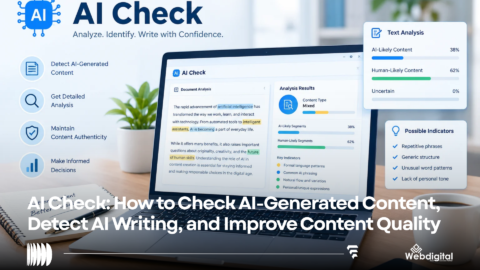







An AI checker analyzes text to generate an estimate as to whether the text was written by a human or by artificial intelligence. Students, teachers, bloggers, SEO professionals, editors, and companies check text with AI checkers to assess originality and understand how text was generated.
As the use of AI writing assistants such as ChatGPT, Google Gemini, and others, has increased, so has the need to check text for potential machine generation. Detecting AI-generated text is an imprecise science. An AI checker can produce a false positive and incorrectly flag text as AI-generated. It can also produce a false negative and fail to flag AI-generated text.
What Is an AI Checker?
An AI checker is a piece of software that identifies text written in a manner resembling machine generation. The software can generate a classification, a probability, highlight text, or create a report.
AI checkers can help with:
- Checking text written with the assistance of AI.
- Identifying signs of text generated with the assistance of AI in an essay or article.
- Checking text written by a freelancer or submitted for editorial approval.
- Highlighting text that may require more in-depth review by a human.
- Identifying text that is inconsistent with the overall tone or style of the site prior to publishing.
- Supporting academic integrity and quality workflows.
The key thing to understand is that AI checkers estimate the likely origin of text. They don’t prove who wrote it or that a certain AI model was used.
How Does an AI Checker Work?
AI checkers typically use a machine learning model that is trained and evaluated using examples of both human-written and AI-generated text. These models identify writing patterns and try to differentiate between the two.
1. Word choice and language patterns
AI-generated text uses similar word choices and transitional phrases. Phrases may also be consistently structured, and paragraphs may be consistently ordered. Patterns may also be used as signals.
However, professional writers, especially in the fields of technology, academia, and business, may use conventional language.
2. Writing consistency
Variations in sentence length, vocabulary and structure may be indicative of human writing. A body of writing with consistent language may be classified as AI-generated. However, variation among AI systems may be misclassified.
3. Classification using ML
A machine learning model is used to classify the characteristics of the text, based on what was learned during model development. The model identifies patterns and compares it to what it was trained on.
Different AI Checkers may yield varying results, depending on the threshold and definitions for AI-generated text.
4. Analysis of individual passages
Some tools evaluate individual passages, and others analyze an entire document, and provide an overall assessment.
Although longer texts can provide additional context for analysis, this does not guarantee accuracy. Individual sentences should not be considered evidence of authorship.
As an example, GPTZero describes its current detector as employing a deep-learning method as opposed to using the more out-dated methods of perplexity and burstiness. Because of this, explanations of detection methods should be reviewed against current materials as opposed to being repeated verbatim.
How to Use an AI Checker
A AI checker can be used to assess AI content as part of the review process of a draft, but a score should not be considered the last word in an assessment.
Choose a tool that is best aligned to your purpose. A student reviewing a draft may need a different feature set from an editor checking a submission or an SEO agency auditing content.
Based on your needs, review the tool’s language and text support, limits, and terms of use. Consider the available reporting and check if a free version is offered.
Prepare the text you want assessed. Copy a meaningful section of the document as opposed to reviewing one short sentence.
Upon uploading the document, the service will generate an estimated AI likelihood, assessment, or report.
Become familiar with the tool’s scoring system before interpreting the result.
Step 4: Review flagged passages
Look for things like repetitive wording, unsupported claims, vague or generic explanations, and unclear reasoning. Look for sections that need supporting evidence.
Remember, a highlighted sentence is a reason to review a text. It does not mean the student used AI.
Step 5: Edit to correct or improve passages
Make corrections to enhance accuracy and/or clarity. Reword to cut unnecessary or repetitive wording. Add reasoning or examples to support claims.
Make edits to enhance usefulness rather than simply to adjust the detection score.
Step 6: Consider the bigger picture
Look at the student’s whole draft, including source materials, personal notes, and version history. Take into account applicable institutional or workplace policies.
A single detector score should not impact your final decision.
How to Choose the Best AI Checker Tools
The best AI checker for a given situation varies. Features and prices change, and different products perform best for detection based on the language used. Compare current documentation and independent reviews to help make an informed decision.
Here are some established options.
1. GPTZero
GPTZero focuses on AI detection and offers document-level and passage-level analysis. This can be used by educators, students, and writers to gain more information about reviewed flagged passages.
Consider it when reviewing long documents and essays.
1. gptZero
gptZero is a free-to-use GPT-3 integration tool. It supports the checking of text generated by large language models. gptZero is essentially a free, online GPT-3 tool.
For: Individuals, teams, and organizations interested in GPT-3-based tools.
Website: https://gptzero.me/
2. Turnitin
Turnitin offers AI writing detection within its academic integrity products. Availability is generally restricted to an institution’s subscriptions and configurations, thus public individual use is limited.
For: Schools, colleges, and universities that use Turnitin’s academic workflow.
Website: https://www.turnitin.com/
3. Copyleaks
Copyleaks offers content analysis products with AI functionalities and plagiarism-related services. Check your desired features and supported languages before buying.
For: Organizations and teams that require document review workflows.
Website: https://copyleaks.com/
4. Originality.ai
Originality.ai provides content detection and quality-related services for professional content teams. Check features and plans prior to purchase.
For: Professional content and website publishers that require review of submitted content.
Website: https://originality.ai/
5. QuillBot
QuillBot offers writing-related services and tools along with AI detection, and writing tools. Limitations may apply based on your product and plan.
For: Writers interested in using a suite of tools for writing assistance.
Website: https://quillbot.com/
Free AI Checker vs. Paid AI Detector
A free AI checker can provide a quick assessment of AI-generated content, and a paid product can offer advanced reporting and usage limits. If you need to check a lot of content regularly and the results can impact your work, consider purchasing a product.
FEATURE
Free Checker
Paid Checker
Basic Text Analysis
Usually Available
Usually Available
Text or Scan Limits
Restrictive
Limits Vary
Detailed Reports
Limited
More Detailed Reports
Workflows
Vary
Often Available in Business Plans
Privacy and Data
Must Be Reviewed
Must Also Be Reviewed
Accuracy
Not Verified
Not Verified
While a paid subscription can give a detector a competitive edge, that doesn’t always ensure it will accurately verify AI-generated content. Look for something that explains the basis for their determination and appropriate limits, and ensures privacy.
Can an AI Checker Detect ChatGPT Content?
Patterns associated with ChatGPT’s generated text may be identifiable using an AI checker. However, an AI checker cannot definitely identify text as being written by ChatGPT in every case.
This becomes more complicated if the content has been edited or rewritten, or if it’s been combined with human generated text or has been translated. Formal human writing can also contain similar patterns that may be associated with AI content.
An AI checker can’t identify which AI content model was used to create the text. It may produce a results indicating AI-generated content, but that doesn’t mean that’s how the text was actually created.
To better understand your review, consider the context of the document. Look at the review process, drafts of the document, and other evidence related to the document.
Are AI Checkers Accurate?
AI checkers can be effective, but the reliability will vary based on the detector, language, type of document, length of text, and the conditions of the test.
There are two main types of error:
- False Positives: Human-written text is incorrectly classified as AI-generated text.
- False Negatives: AI-generated text is incorrectly classified as human-written text or is not identified as AI-generated text.
There are other limiting factors to the classification. For instance, OpenAI’s English challenge set classifier stated it was only 26% confident in determining AI-written text. The classifier also incorrectly identified 9% of human-written text as AI-generated text. OpenAI discontinued the classifier in July 2023 due to a number of inaccuracies.
Those types of errors demonstrate why we need to evaluate detection accuracy in the right context.
Compare the accuracy of the test against the types of text the vendor or researcher tested. Look for false positives, false negatives, length of the document, languages covered, and if the test set reflects real world writing.
Keep in mind, detection by an AI checker is not proof of human authorship.
AI checkers and plagiarism checkers both address different questions. A plagiarism checker attempts to find similar text in available sources. An AI checker determines how similar a given text is to a sample of generated text.
For example, an author could write a completely original article with the help of an AI assistant. An AI detector could flag the article, but a plagiarism checker might not detect any duplicate text in the article.
Alternatively, someone could copy text from an article on a website without using AI. A plagiarism checker would identify the copied text and flag it as plagiarism.
Some products integrate both AI detection and plagiarism checking. The results from the two scans should be evaluated separately. Neither scan replaces a fact-check or editorial judgment.
How to Choose the Right AI Checker for Your Needs
Prior to selecting a product, you should ask yourself:
- What are you checking? Whether it be essays, articles, business reports, or large content submissions, you may need to adjust your workflow to fit the product.
- In what languages do you work? For accuracy, make sure the product supports the languages you work in.
- How large is the document? See if there are restrictions on document size.
- Do you understand the results? Look for explanations for the results.
- What happens to the text you submit? See what the company says about retaining the data you submit.
- Can you independently verify how the product works? Look for independent tests of the product.
- Can you afford the product? See what the prices are and compare to similar products.
For important decisions, look for products that fit your needs, and determine what the scores mean before relying too heavily on a product.
Should SEO Professionals Use an AI Checker?
SEO professionals can use AI checkers to identify potential issues in large batches of content, or help with consistency checks for articles submitted by external writers.
However, an AI checker is not a ranking predictor for search engines. Just because a piece of content scores low using an AI checker does not mean search engines will rank that page low. Conversely, a piece of content scoring high using an AI checker does not mean search engines will rank that page high.
In order for content to rank well, search engines look for relevant, high-quality content that satisfies a searcher’s intent. According to Google, good content should be created with a purpose and provide value for its readers. Content should not be generated solely to manipulate search engines.
A more helpful review checklist for SEO professionals would be the following:
- Does this content provide value?
- Is this content supported by reliable sources?
- Is this content useful and informative?
- Is this content free from grammar and spelling errors?
- Do examples and illustrations provide relevant information?
- Are headings and paragraphs relevant?
- Are disclosures and author credentials accurate?
- Are examples and illustrations clear?
- Does content promote usefulness and trust?
AI detection and review can help prioritize which sections to review, however reviewing content should always be done with the purpose to provide trust and value.
Read the provider’s explanation of the score.
Checking only a short excerpt
A short passage may not contain enough linguistic patterns to analyze, and, as a result, may produce an unstable score. Follow the tool’s recommendation on the length of the passage, and be cautious interpreting results for short texts.
Assuming all detectors agree
Different systems may classify the same passage differently. This can happen with systems that use different models and thresholds.
Rewriting solely to lower the score
Merely changing words to obtain a lower score does not help determine if the passage is original or if the facts in the passage are true. Revise the passage to improve the overall quality and other things like reasoning and evidence instead.
Ignoring privacy
Certain AI text checkers process the submitted text on their servers. Check the tool’s privacy policy before submitting confidential, unpublished, or sensitive text.
Frequently Asked Questions about AI Checkers
What is the best free AI checker?
The best free AI checker depends on what you want to check and how long the text is. Compare results from free versions of QuillBot and GPTZero, check features and limits, and use results cautiously.
Can an AI checker spot text from ChatGPT?
AI checkers may detect patterns associated with text generated by ChatGPT. However, they can’t always spot generated text and definitely can’t prove ChatGPT wrote a certain text.
3. Can human-written content be flagged as AI?
Yes, this is called a false positive. Content that is formal, repetitive, or otherwise predictable may be flagged. A detector score should not be the only source of evidence used to make a case against a student.
4. Is an AI checker the same as a plagiarism checker?
No, an AI checker assesses similarity to AI content. A plagiarism checker compares content to publicly available sources. Some tools offer both functions.
5. Can an AI checker identify the exact AI model?
In most cases, a detector cannot name the specific AI model that generated a given text. The detector may indicate coverage of various AI model families, but that does not mean it can confirm exact authorship.
6. Does a low AI detection score mean content is human-written?
Not necessarily. A low score means the tool did not find sufficiently strong AI signals to raise a flag. A model could have generated the content with high fidelity and yet still receive a low score.
7. Should schools trust AI detection scores?
No, Schools should follow their academic integrity policies and consider multiple sources of evidence. Detector results can be one of the sources, but they should not be the sole evidence to take action against a student and replace a fair process.
1. Does Google penalize content because an AI checker flags it?
Just because an AI checker flags something, doesn’t mean Google will take action against that content. When evaluating content, Google looks at the quality and the purpose of that content. Content generated by a user to manipulate Google’s rankings by using AI is still violating Google’s policy on spam.
2. Is it safe to paste my article into an AI checker?
It depends on the data security practices of the provider. Read their policies and terms before giving access to unpublished, private, or sensitive content.
3. How often should I check my content?
Use an AI checker to review a draft or assess content that has been submitted for review. Determining the quality and accuracy of content through review and compliance with company policies is far more valuable than constantly checking content with an AI checker.
Conclusion
An AI checker can help evaluate written content and identify areas that need further analysis. The worth of an AI checker is based on determining the appropriate tool for the job and evaluating the results within limits.
When selecting an AI checker, consider their language options, data security and privacy, reporting capabilities, and independent assessment of that tool. When evaluating results, consider the entire content and look for additional evidence to determine authorship.
The best approach for students, educators, writers, publishers, and SEO professionals is to integrate and balance the use of these tools along with their own critical thinking skills. Use an AI checker to review and assess content, not to replace that critical thinking.